OSHA Jobsite Toilet Requirements, in Plain English
This guide explains OSHA porta potty requirements for construction sites and farms in plain words, with the exact table and links to the rule.
Jobsite toilets
OSHA 29 CFR 1926.51, Table D-1
- 20 workers or fewer
- 1 toilet
- 20 or more
- 1 seat + 1 urinal per 40
- 200 or more
- 1 seat + 1 urinal per 50
- Handwashing
- Required, 1926.51(f)
Delivery area
Federal OSHA rules apply on South Carolina jobsites; local codes can add more.
Arrival
Same-day jobsite delivery when you call by noon inside our Upstate route area.
Which unit
Each standard unit has one toilet seat and one urinal, the Table D-1 pair.
Cleaning
Weekly pump, wash, sanitize and restock is included on every jobsite cycle.
Full cost
Itemized cycle quote: unit, first delivery, weekly service and tax; no removal fee.
What does OSHA Table D-1 require?
OSHA Table D-1, in 29 CFR 1926.51(c)(1), sets the minimum toilets for construction sites. Twenty or fewer employees need 1 toilet. Twenty or more need 1 toilet seat and 1 urinal per 40 workers. Two hundred or more need 1 toilet seat and 1 urinal per 50 workers.
Here is Table D-1 as written in the rule.
| Number of employees | Minimum number of facilities |
|---|---|
| 20 or less | 1 |
| 20 or more | 1 toilet seat and 1 urinal per 40 workers |
| 200 or more | 1 toilet seat and 1 urinal per 50 workers |
Paragraph (c)(2) adds that under temporary field conditions, at least one toilet facility must be available. Paragraph (c)(3) lets sites without a sanitary sewer use chemical toilets, recirculating toilets, combustion toilets or privies, unless local codes say otherwise. A portable toilet is a chemical toilet.
Read the full rule at OSHA.gov 1926.51 or the official text on eCFR.
How do I count workers for Table D-1?
Count the most workers on site at one time, including subcontractors. Each standard porta potty has 1 seat and 1 urinal, so one unit covers one Table D-1 pair. A crew of 45 needs 2 units, and a crew of 260 needs 6 units as the legal minimum.
Use the peak day, not the average. Framing week and drywall week can double a crew. The table below applies Table D-1 to common crew sizes.
| Workers on site | Legal minimum (seats + urinals) | Standard units with seat and urinal |
|---|---|---|
| 5 | 1 toilet | 1 |
| 15 | 1 toilet | 1 |
| 20 | 1 toilet | 1 |
| 30 | 1 seats + 1 urinals | 1 |
| 45 | 2 seats + 2 urinals | 2 |
| 80 | 2 seats + 2 urinals | 2 |
| 120 | 3 seats + 3 urinals | 3 |
| 199 | 5 seats + 5 urinals | 5 |
| 200 | 4 seats + 4 urinals | 4 |
| 260 | 6 seats + 6 urinals | 6 |
The rule does not spell out how a sub's crew is counted against the general contractor's toilets. Most sites count everyone who works there. Confirm with your safety officer.
Get jobsite toilets delivered: call now, or get a free written quote by text.
(864) 209-8789Free quoteWhat does 1926.51(f) say about handwashing?
Section 1926.51(f)(3) says lavatories shall be made available in all places of employment. Each lavatory needs running water, hand soap, and individual towels or air blowers. Section 1926.51(f)(1) also requires washing facilities near the work for crews using paints, coatings, herbicides or insecticides.
The rule text calls for hot and cold running water, or tepid running water, at each lavatory. Mobile crews and normally unattended sites are exempt when workers have transportation readily available to nearby washing facilities.
What does 'readily available' mean for mobile crews?
Section 1926.51(c)(4) exempts mobile crews that have transportation readily available to nearby toilet facilities. A crew with a work truck and a public restroom a few minutes away may qualify. A crew without a vehicle on site, or far from any restroom, needs a toilet at the site.
The rule does not set a distance or a number of minutes. In practice, a crew qualifies only when a worker can leave and reach a usable restroom without waiting on a ride.
- Utility and line crews that move every few hours often qualify.
- Roofers on a house for 3 days, with one truck parked at the supply house, usually do not.
- A store restroom that bans contractors does not count.
When in doubt, place a unit. A single standard unit on a 28-day cycle costs less than a citation.
What do farms need under OSHA 1928.110?
OSHA 1928.110 covers farms where 11 or more employees do hand labor in the field on any given day. Farms must provide 1 toilet and 1 handwashing facility for each 20 employees or fraction, within a quarter-mile walk. Work lasting 3 hours or less, including travel, is exempt.
The rule also requires potable drinking water placed where all workers can reach it. Toilets and handwashing facilities must sit close to each other.
| Hand laborers in the field | Toilets | Handwashing facilities |
|---|---|---|
| 1 to 10 | Rule does not apply | Rule does not apply |
| 11 to 20 | 1 | 1 |
| 21 to 40 | 2 | 2 |
| 41 to 60 | 3 | 3 |
Read the rule at OSHA 29 CFR 1928.110. Towable units on a trailer make the quarter-mile walk easy to keep as crews move.
How does the legal minimum compare with our recommendation?
The legal minimum is the floor, not the goal. Table D-1 allows 1 toilet for up to 20 workers, and our recommendation adds a second unit or an extra weekly service when 10 or more workers share one unit in June to August heat. Anderson's average July high is 90.7°F.
| Site | OSHA legal minimum | Our recommendation |
|---|---|---|
| 8 workers, spring | 1 toilet + lavatory | 1 standard unit + 1 hand wash, weekly service |
| 18 workers, July | 1 toilet + lavatory | 2 units, or 1 unit with 2 services a week, + hand wash |
| 45 workers | 2 seats + 2 urinals + lavatories | 3 units spread across the site + 2 hand wash |
| Site with public visitors | Table D-1 for workers | Add a wheelchair-accessible unit |
| Crane or high-rise work | Table D-1 | Units on upper staging, so workers do not lose 20 minutes per trip |
More jobsite setup advice is on the construction site toilet page.
Get jobsite toilets delivered: call now, or get a free written quote by text.
(864) 209-8789Free quoteDoes a jobsite need a wheelchair-accessible unit?
Table D-1 does not require a wheelchair-accessible unit. A jobsite still needs 1 when a worker with a disability needs it, and sites open to the public may fall under the 2010 ADA Standards. The Satellite Freedom unit has a 60-inch turning space and a ground-level floor.
Model homes, sales trailers and public projects often draw visitors. Ask your permit office whether an accessible unit is expected. The 2010 standards are at the ADA.gov design standards page.
How often must jobsite toilets be cleaned?
Table D-1 sets toilet counts but does not set a cleaning schedule. Section 1926.51(f)(2) says washing facilities shall be kept in a sanitary condition. Our standard is 1 service visit per week on every jobsite rental, with a second weekly visit for 10 or more workers in summer heat.
Weekly service is included in the 28-day cycle price. Each visit has 5 parts.
- Pump the 60-gallon tank.
- Each visit should wash and sanitize the seat, walls, floor and urinal.
- Refill the blue deodorizer.
- Restock toilet paper and hand sanitizer.
- Refill hand wash stations with water, soap and towels.
All waste goes to approved disposal sites under SCDES R.61-56.1. Heat speeds odor, so read our post on summer servicing before a July pour.
Where should jobsite toilets go?
Jobsite toilets go on level, firm ground near where crews work, with a clear path at least 10 feet wide for the service truck. Keep units at least 10 feet from food and break areas. On sites with 2 or more work zones, split units so no one walks far.
Placement affects both use and service. A unit behind a dumpster gets skipped and a unit in a mud hole cannot be pumped.
- Put units on gravel or plywood over red clay, which turns slick after rain.
- Keep units off public sidewalks and road shoulders. Units on a state right-of-way may need an SCDOT encroachment permit.
- Stake or strap units before summer storms and high wind.
- For moving sites, a towable unit on a trailer moves with the crew.
Do sites with indoor restrooms still need a porta potty?
A building restroom counts toward Table D-1 only when workers may use it during the whole shift. Many owners close finished bathrooms to crews to protect new fixtures, and a water shutoff closes them too. In those cases, the site needs at least 1 portable toilet.
Remodels are the common case. The homeowner's bathroom may be torn out, under tile or off-limits. Ask the owner in writing whether crews may use indoor restrooms, and plan a unit if the answer is unclear.
- Occupied home remodels: 1 unit by the driveway keeps crews out of the house.
- Commercial fit-outs: building restrooms may close during plumbing work.
- New construction: no restroom works until final plumbing, so a unit stays from day 1.
Our post on porta potties during a home remodel covers placement on a lived-in lot.
Jobsite toilet checklist
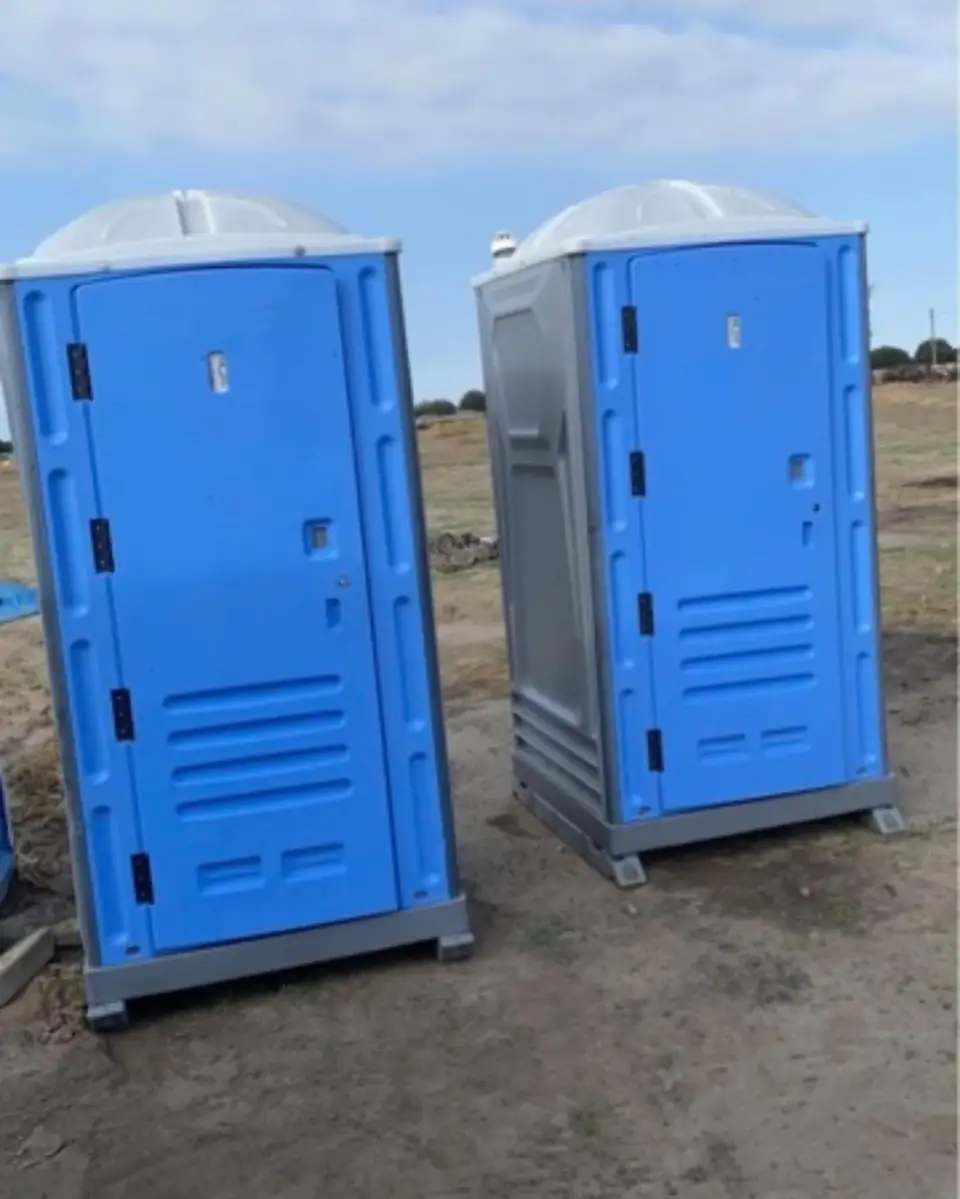
A jobsite toilet setup passes most inspections when it meets 7 checks: the right count from Table D-1, a lavatory with soap and towels, a level spot, weekly service, toilet paper on hand, a working door latch, and a clear truck path. Our weekly service covers 4 of the 7.
- Count the peak crew and check Table D-1.
- Set a lavatory with soap and individual towels near the toilets.
- Place units on level, firm ground, on gravel or plywood over red clay.
- Keep a clear path at least 10 feet wide for the service truck.
- Confirm weekly service: pump, wash, sanitize, restock.
- Check the door latch and vents each week.
- Before summer storms, stake or anchor each jobsite unit.
Is this page legal advice?
This page is general information, not legal advice. OSHA rules change, local codes add their own rules, and inspectors read rules on site. Confirm your count with your safety officer, your permit office or the OSHA area office. The 3 links below go to the official rule text.
- Construction toilets: OSHA 29 CFR 1926.51
- Construction toilets, official text: eCFR 29 CFR 1926.51
- Farm field sanitation: OSHA 29 CFR 1928.110
Anderson County Building and Codes and other county offices are listed on our Anderson County page.
Questions renters ask before booking
The county code says we need a toilet on site. How soon can a unit arrive?
Inside our Upstate route area, call by noon Monday through Saturday for same-day delivery. A same-day rush charge starts at $65 and shows on the quote. Next-morning delivery avoids the rush charge.
Does a one-man crew need a porta potty?
Table D-1 calls for 1 toilet for 20 or fewer employees, which includes a crew of one. A mobile worker with a truck and a nearby restroom may fall under the readily available exemption. Ask your safety officer.
Can two job sites two minutes apart share one toilet?
Each site usually needs its own toilet under Table D-1, because workers cannot leave every time. Two sites are two drop points on one account, and both can be on the same service route.
Is a hand sanitizer dispenser enough for handwashing?
Section 1926.51(f)(3) calls for lavatories with water, soap and towels. Sanitizer in the unit helps, but a hand wash station is the safer choice. A two-station hand wash starts at $95 per 28-day cycle.
How much is a jobsite toilet with weekly service?
A standard jobsite unit starts at $155 per 28-day cycle with weekly service, plus a one-time delivery fee starting at $45 on the first cycle. Your itemized quote is final, and there is no removal fee.
Do roofing crews that are only on site a few days still need a toilet?
A roofing crew on site for 3 to 5 days still falls under Table D-1 unless the crew has transportation readily available to a nearby restroom. A short-term unit or one 28-day cycle covers the job.
Can we get a price for a toilet and hand wash program to put in a bid?
Send the project address, start date, length and peak crew size. We return a written quote by email with cycle prices for toilets and hand wash stations, ready to drop into your bid.
Get an itemized quote
Seven quick fields. We price from your ZIP and text or email the full breakdown. Need it today? Call instead.
Ready for delivery in Anderson? Call by noon for same-day delivery, or get an itemized quote by text.
(864) 209-8789Free quote